The
Receipts.
Current AEO/GEO work at Cura Resource Group, plus SEO tool screenshots showing what changed for Wrangler and PureWay. Click any image to zoom in.
Cura Resource Group
AEO / GEO · CurrentResult: Cited in a Google AI Overview. Site-wide average position ~51 → ~20 in one quarter.
B2B third-party logistics brand. My remit is organic growth end to end — but the interesting half of this job is answer engine optimization: making the site eligible to be quoted by AI Overviews, ChatGPT and Perplexity, not just ranked by Google. Below is the actual work, including the part that was quietly broken.
The Headline Result
A cluster post earned a Google AI Overview citation
The order-fulfillment guide is cited as a source in Google's AI Overview for "order fulfillment process" — appearing alongside Oracle NetSuite and Esker on a head term where a mid-size 3PL has no business outranking enterprise software. That did not happen by accident — it was built answer-first: the opening sentence is a clean standalone definition with no throat-clearing, every FAQ answer sits in the 40–58 word range AI engines actually lift, key questions appear in both an H2 and the FAQ in deliberately different wording so either passage can stand alone, and a comparison table gives the engine something structured to extract.
The approach follows the Princeton GEO study (KDD 2024), which measured citing sources at +40% visibility and adding statistics at +37% — while keyword stuffing scored −10%. The page carries in-sentence source attribution and an explicit Sources section. I then reverse-engineered it into a repeatable template for the rest of the content programme.
Found a silent schema failure
26 of 29 posts repaired
Every post declared FAQPage schema, so every surface-level check passed. Parsing the JSON showed mainEntity was empty — the node existed but contained no questions, making the FAQs ineligible for AI extraction site-wide. Traced it to a global plugin record stamping a blank template over the hand-written markup. Removed it and generated valid FAQPage JSON-LD from the live Q&A pairs.
AI crawler access audit
GPTBot · PerplexityBot · ClaudeBot
Verified that GPTBot, ChatGPT-User, PerplexityBot, ClaudeBot and Google-Extended all reach the site unblocked, and confirmed verified Bingbot passes the CDN's bot filtering — which matters more than it looks, because ChatGPT search and Copilot both draw on Bing's index. Being invisible to Bing means being invisible to them. Also audited the auto-generated llms.txt, which listed only 5 of 29 posts plus junk sections.
Targeting by AI presence, not volume
SERP-feature-led keyword selection
Standard keyword research optimises for search volume. For AEO that is the wrong filter — a 1,900-volume head term with no AI Overview cannot produce a citation no matter how well it is written. I select targets from the SERP-features column instead, prioritising low-difficulty question keywords that already trigger AI Overviews, then write the answer into both an H2 and the FAQ.
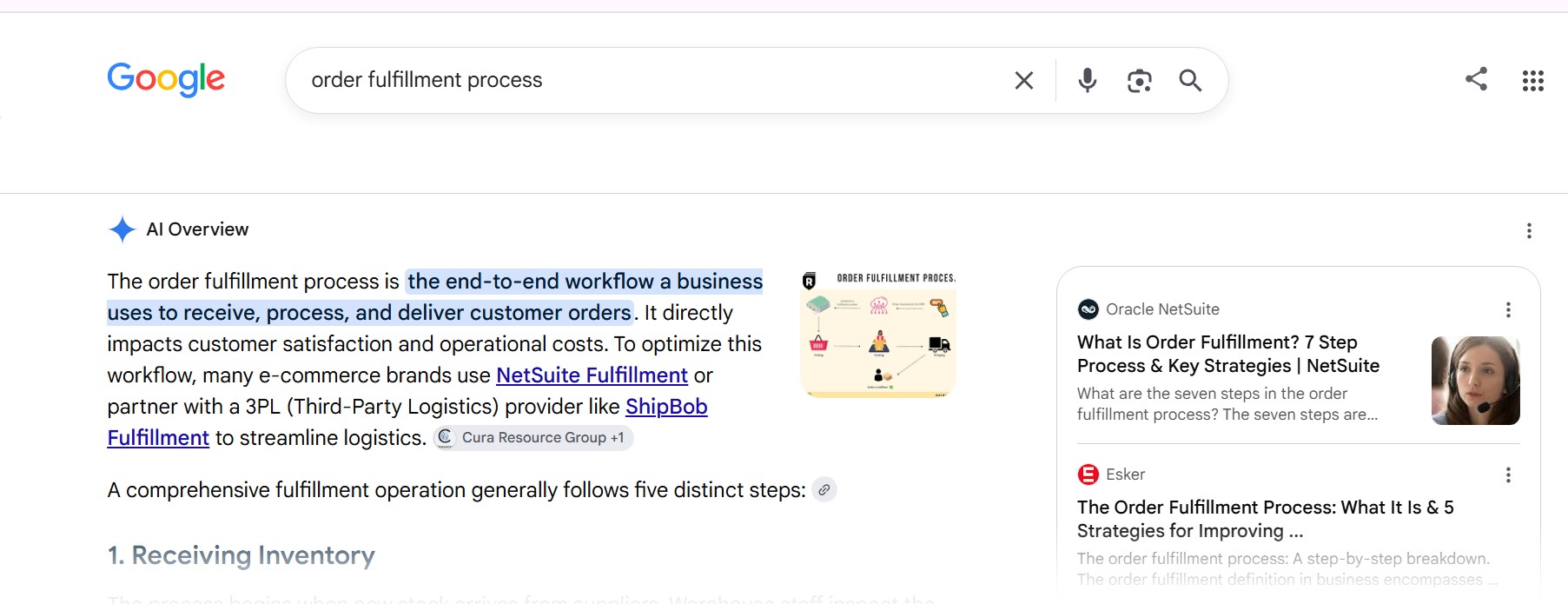
Cited in Google's AI Overview
Query: "order fulfillment process"
Google's generated answer carries Cura Resource Group as a cited source, on a query whose other citations are Oracle NetSuite and Esker. Captured July 2026 — AI Overviews are regenerated continuously, so this is a point-in-time record rather than a permanent state. Click to enlarge.
The defect, in code
Illustration, not a screenshotBoth blocks below are valid JSON-LD and both contain the string FAQPage — which is why a search for that string reported a pass on all 29 posts. Only one of them is actually eligible for extraction.
Before · emitted on every post
{
  "@context": "https://schema.org",
  "@type": "FAQPage"
}

// No mainEntity. The node exists, declares
// itself a FAQPage, and contains zero
// questions. Nothing to extract.
Produced by a single global plugin record set to "enable on: post", which stamped this blank template across the whole site and suppressed the hand-written FAQ markup underneath it.
After · generated from the live Q&A pairs
{
  "@context": "https://schema.org",
  "@type": "FAQPage",
  "mainEntity": [{
    "@type": "Question",
    "name": "What is the order
             fulfillment process?",
    "acceptedAnswer": {
      "@type": "Answer",
      "text": "The order fulfillment
        process is the complete
        sequence of steps a business
        follows from…"
    }
  }]
}
Rebuilt from each post's existing h3 + p pairs and applied across the 26 posts that have a FAQ section. Answers kept in the 40–58 word band that AI engines actually lift.
The lesson I took from this: validate schema by parsing it and asserting the fields are populated, not by checking that the type name appears. A string match passes on an empty node — which is exactly how this survived unnoticed across 29 posts.
Client analytics are commercially sensitive, so figures here are stated as relative movement rather than raw traffic totals. Full detail available on request in an interview.
On Wave Group
SaaS & Agency · 2024–25Result: Organic CTR +18% in six months. 25+ keywords into Google's top 10.
SaaS product portfolio plus a rotating set of agency-managed client accounts across other industries. Multi-client work, which means limited time per account and no room for a strategy that only pays off in year two.
The Approach That Worked
+18% CTR without moving a single ranking
Ranking higher is slow and expensive. Earning more clicks at the position you already hold is neither. Most of these pages were already sitting on page one and being scrolled past, so I rewrote titles and meta descriptions against actual query intent, deployed structured data to qualify pages for rich results, and targeted the SERP features that push a listing above the fold.
The result was a 18% lift in organic click-through rate inside six months — traffic gained from impressions that were already being served. On a multi-client roster this matters twice over: it is the fastest lever available when you cannot spend eighteen months building authority for every account.
25+ keywords into the top 10
Within six months
Content optimisation, authority link building and technical SEO run together rather than sequentially. Backlink prospecting and outreach workflows built in Ahrefs and Snov.io — the same outbound discipline I apply to cold email, pointed at editors and site owners instead of buyers.
Intent mapping across the funnel
Keyword mapping & content-gap analysis
Mapped keywords to URLs and stages so editorial output matched what buyers were actually searching at each step, then ran content-gap analysis against competitors to find what the portfolio could rank for but had never covered. This is also the discipline that prevents pages cannibalising each other — a common failure when several writers target one topic cluster.
Less dependence on paid
Improved acquisition efficiency
Qualified leads generated through combined organic and outreach motions, which reduced how much of the pipeline had to be bought. Organic compounds and paid does not — every lead that arrives through search instead of spend improves blended acquisition cost permanently, not just for the month.
Agency client accounts are covered by confidentiality, so this engagement is described by method and outcome rather than named brands or dashboards.
Wrangler
Ecommerce · 2022–24Result: Organic traffic 6k → 24k a month. DA 22 → 34.
Apparel ecommerce, Australian market. A large product and category catalogue that was already being crawled — just badly.
The Approach That Worked
400% growth came mostly from fixing what was already there
The instinct on a stalled ecommerce site is to publish more. The catalogue here did not need more pages — it needed the existing ones to be crawlable, distinct, and internally connected. I cleared broken links, redirect chains, duplicate content and canonical misconfigurations, which cut crawl errors by 35% and freed crawl budget that was being spent on pages nobody was meant to see.
On top of that: semantic keyword clustering so product and category pages stopped competing with each other, an internal-linking architecture that pushed authority to the pages that could convert, and schema markup across the catalogue. Traffic went from 6,000 to 24,362 monthly visits over 18 months, with 822 ranking keywords and "mens jeans australia" at #1. The dashboards below are the receipts.
Technical remediation at catalogue scale
Crawl errors down 35%
Broken links, redirect chains, duplicate content and canonical conflicts resolved systematically rather than page by page. On a catalogue site these compound — every wasted crawl is a product page not being refreshed in the index.
Authority built deliberately
DA 22 → 34 in under 18 months
100+ backlinks earned from ecommerce and industry publications. Twelve points of domain authority is the difference between competing for category terms and not being in the conversation at all.
Clustering and internal architecture
Anti-cannibalisation by design
Semantic clustering mapped each term to exactly one owning page, then internal links routed authority toward the pages that convert. Schema markup across product and category templates to qualify for rich results.
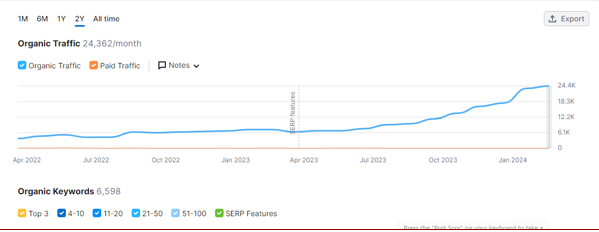
Organic traffic over 2 years
From 6k to 24k monthly visits
SEMrush traffic chart. Steady upward curve from April 2022 to January 2024. Reached 24,362 monthly visits and 6,598 ranking keywords.
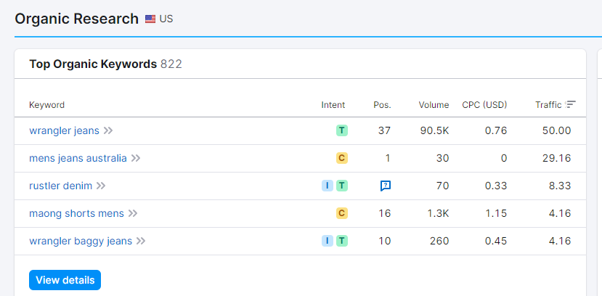
Top keywords ranking
Page-1 keywords with traffic
SEMrush keyword report. Includes 'mens jeans australia' at #1, 'wrangler jeans' bringing 50 daily visits, and 822 total ranking keywords.
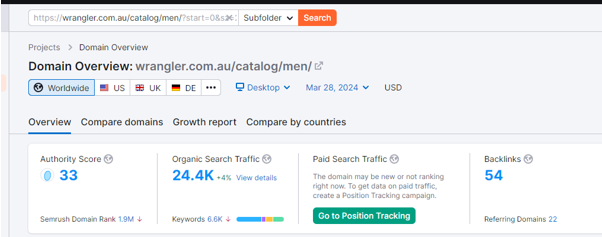
Domain overview
Authority score, traffic, backlinks
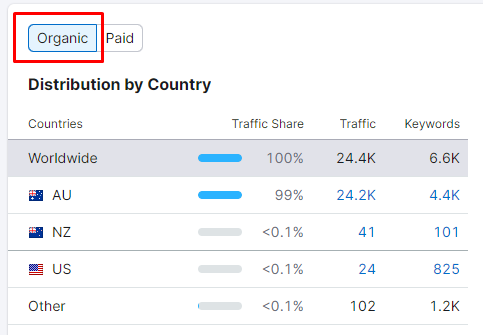
SEMrush domain dashboard for wrangler.com.au. Authority Score 33, 24.4K organic traffic, 6.6K keywords, 54 referring backlinks.
Traffic by country
Where the visitors come from
99% of traffic from Australia (24.2K visits, 4.4K ranking keywords). Local SEO and country-specific content paying off.
PureWay Compliance
Multi-Channel · 2020–22Result: Email opens up 20%. CPC down 20%. Several #1 rankings.
5 Screenshots
Medical waste and environmental compliance — a regulated, low-glamour niche where the buyer is searching for a very specific solution and brand trust decides the sale. This is the engagement where I ran organic, paid and email as one system rather than three.
The Approach That Worked
Three channels compounding instead of competing for budget
Organic, Google Ads and email were treated as one funnel. Paid search data told me which commercial terms actually converted, so those became the organic content priorities rather than whatever had the highest volume. Organic then took over the terms paid was overspending on, and email captured and nurtured the demand both created. Brand search visibility rose 30% and organic traffic 25% year over year, with #1 rankings on "sharps disposal systems" and "medical waste mail back program".
This is also where my email deliverability work started. Fixing SPF, DKIM and DMARC alignment alongside segmentation and A/B testing lifted open rates 20% — the same authentication and reputation discipline I now apply to B2B cold email infrastructure.
Deliverability, not just design
Open rates up 20%
SPF, DKIM and DMARC alignment, list segmentation, and subject-line A/B testing. Most "email underperformance" is an authentication and reputation problem wearing a creative problem's clothes — check the DNS before rewriting the copy.
Paid restructured, spend cut
CPC −20%, ad CTR +15%
Campaign restructuring, tighter match-type and audience targeting, and a disciplined negative-keyword strategy. Cheaper clicks and better click-through at once, because the wasted impressions were removed rather than merely outbid.
Topical authority in a niche vertical
1,798 keywords · 685 referring domains
Legacy content refreshed rather than abandoned, and topical depth built across the compliance niche. Ranking keywords roughly tripled from ~1.3K to over 4K with no ranking drops along the way.
Traffic over time
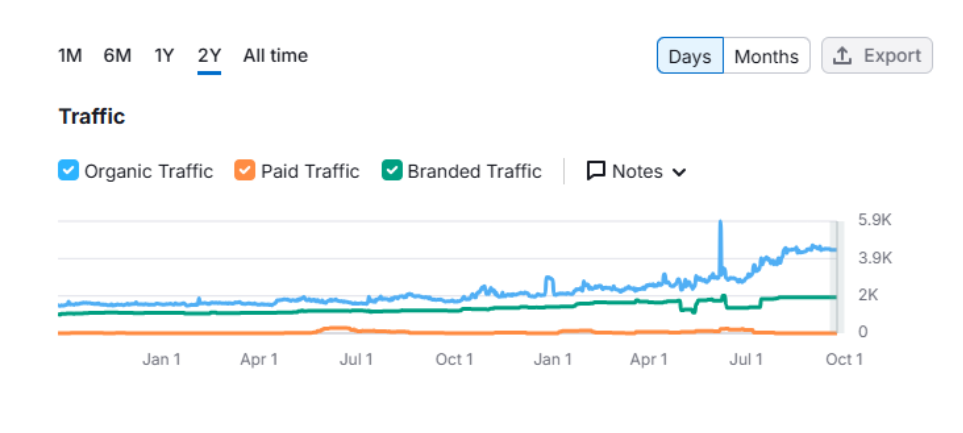
Organic, paid, and branded split
SEMrush traffic chart split by source. Organic line trending up steadily. Paid traffic kept lean while organic carried the load.
Domain overview
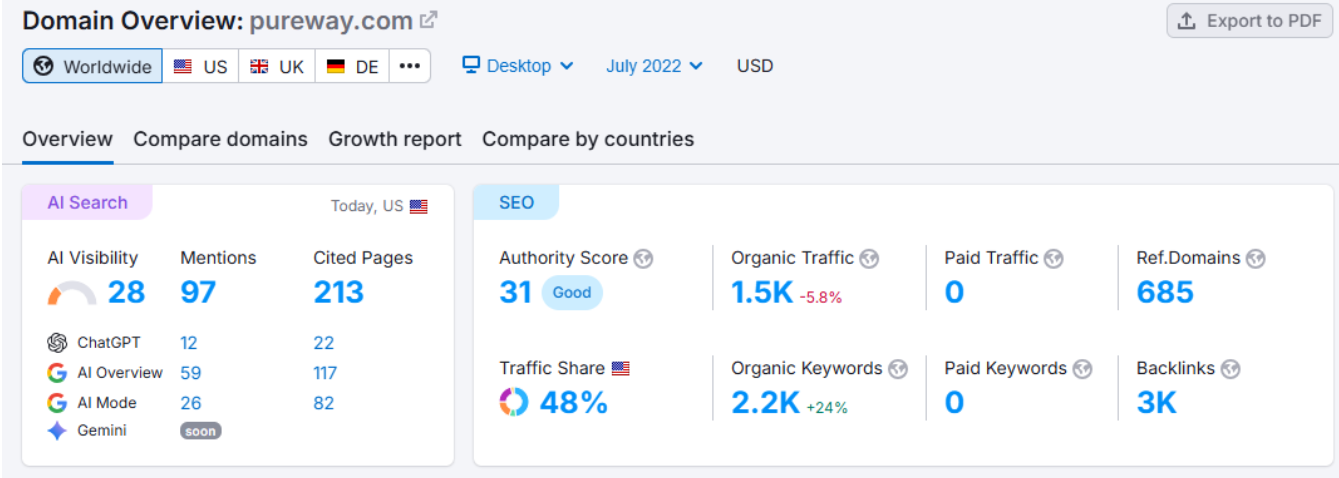
685 referring domains, 3K backlinks
SEMrush dashboard for pureway.com. Authority Score 31, 1.5K organic traffic, 2.2K keywords, 3K backlinks across 685 referring domains.
Keyword positions
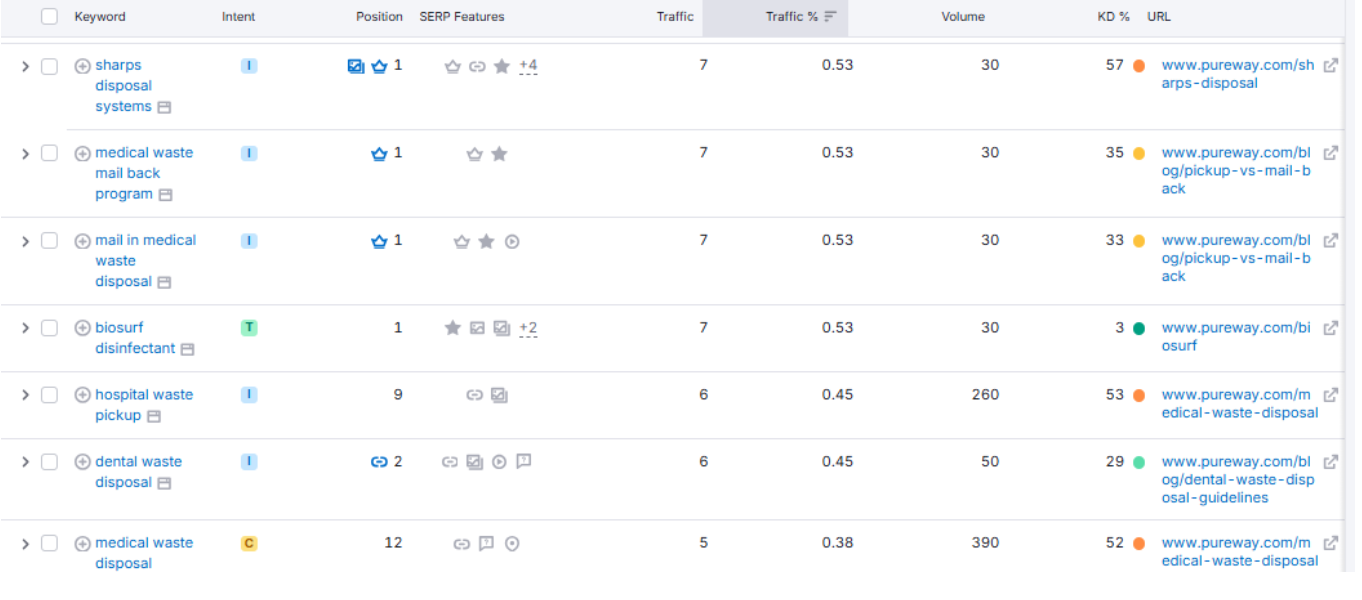
Several keywords ranked #1
Industry compliance keywords ranking #1: 'sharps disposal systems', 'medical waste mail back program', 'biosurf disinfectant'. All driving real traffic.
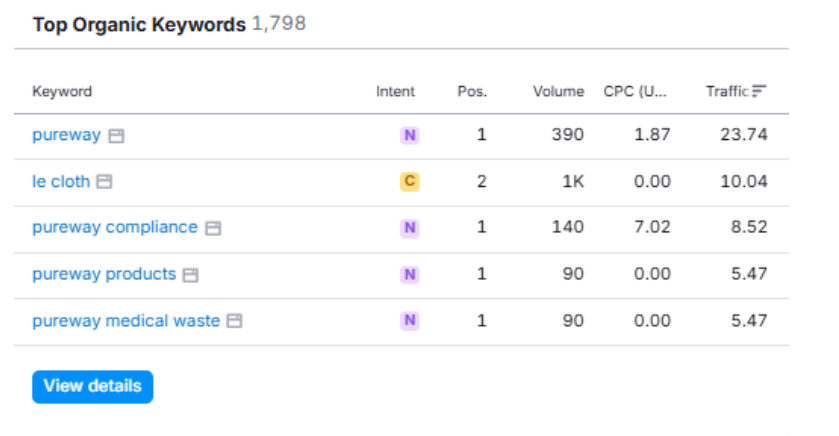
Top organic keywords
Brand and intent keywords on page 1
1,798 ranking keywords. Brand terms ('pureway', 'pureway compliance', 'pureway products') and category terms ('le cloth') sitting in top spots.
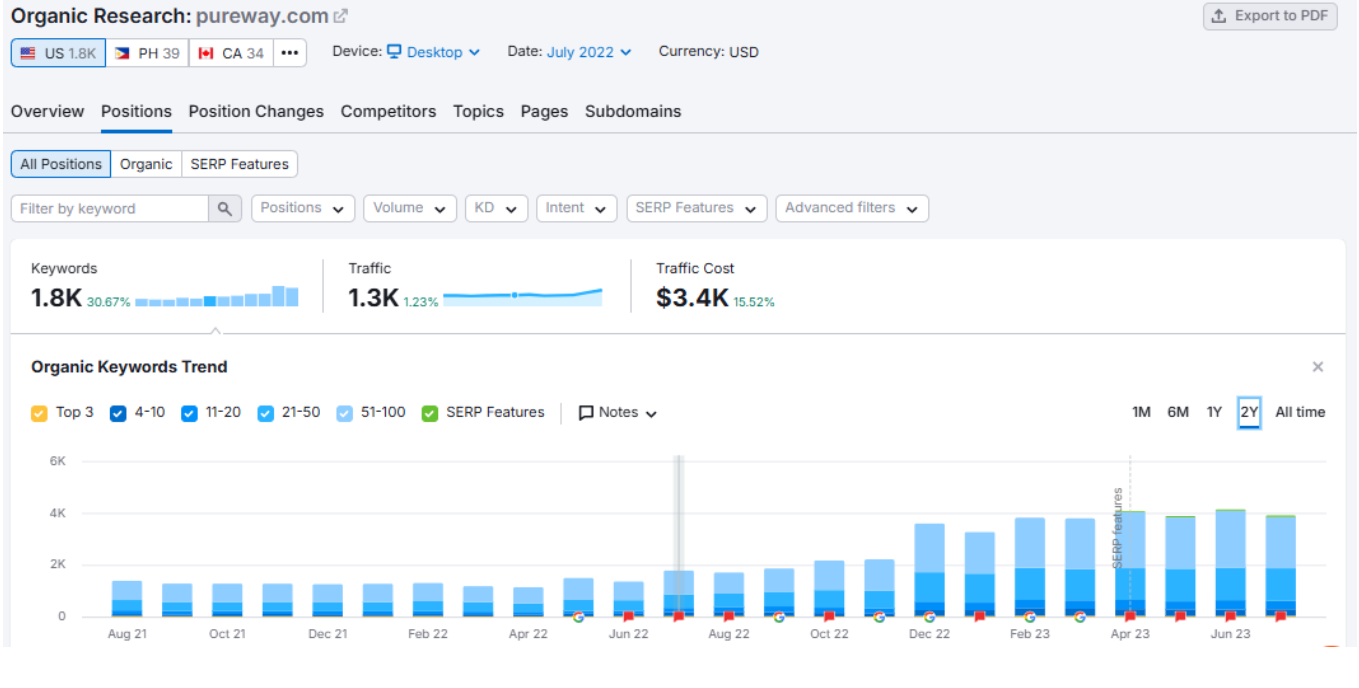
Keywords trend
Two-year keyword growth chart
Two-year keyword growth chart. Total ranking keywords roughly tripled from ~1.3K to over 4K. Steady gains, no ranking drops.